Ask most people what stalls a Paradise Valley sale and they'll guess dated kitchens or an awkward floor plan. The market data from this cycle tells a different story. As of May 2026, the median sale price in town sat near $5.2 million, but the number that should worry sellers more is days on market climbing to 121. That's not a market rejecting a house because of its finishes. That's a market with fewer buyers willing to look past unresolved paperwork, and in Paradise Valley, the paperwork that trips people up almost always traces back to slope.
This town has a small footprint, roughly 15 square miles, and it has kept it that way on purpose. One-acre minimum lots, a Hillside Building Committee that reviews anything built on sloped ground, and height rules measured off natural grade rather than finished grade all exist to protect the mountain views that make the place worth $987 a square foot in the first place. None of that is news to anyone who has shopped here. What's less understood is how those same rules interact with a slower 2026 market to punish sellers and buyers who treat them as a formality instead of a checklist item to close out before the sign goes in the yard.
A Market With Less Room for Sloppy Files
Different sources measure Paradise Valley's pace differently. A Redfin-sourced figure from August 2026 put the average selling period at 91 days, already longer than the year before, while a separate market report tracking the May 2026 closing cycle showed days on market climbing to 121. The two numbers come from different tracking periods and methods, but they point the same direction: buyers are taking longer to commit than they were a year ago. List prices have also pulled back slightly, from around $5.55 million in April 2026 to $5.25 million in May, even as price per square foot pushed higher to $987. That combination, softer list prices but firmer per-square-foot values, tells you the discount is happening on stale or poorly documented properties, not on quality construction.
Cash buyers still dominate the top tier. A meaningful share of recent closings involved no financing at all, concentrated among out-of-state buyers relocating from California and Illinois who prefer to skip jumbo loan appraisal risk entirely. That's a buyer pool with options and patience. When a file is missing permits, or a slope issue surfaces during inspection that wasn't disclosed up front, that buyer doesn't negotiate around it. They move to the next listing.
The Committee Review Most Sellers Underestimate
Paradise Valley's Hillside Building Committee operates under Article XXII of the town's zoning ordinance, and it reviews any new construction, addition, or major remodel on a lot with meaningful slope, generally anything at 10 percent grade or steeper. The committee looks at land disturbance, grading, drainage, retaining walls, exterior lighting, and height before a permit is issued. That's not a rubber stamp. A typical hillside project goes through one to three committee cycles before approval, and submittal deadlines run weeks ahead of the actual meeting dates.
The part that catches people off guard is the disturbance limit itself. The town caps how much of a sloped lot you're allowed to alter, on a sliding scale that gets stricter as the ground gets steeper:
| Building-site slope | Maximum disturbed area |
|---|---|
| 10% | Up to 60% |
| 15% | About 34% |
| 25% | About 13% |
| Beyond 50% | Single digits |
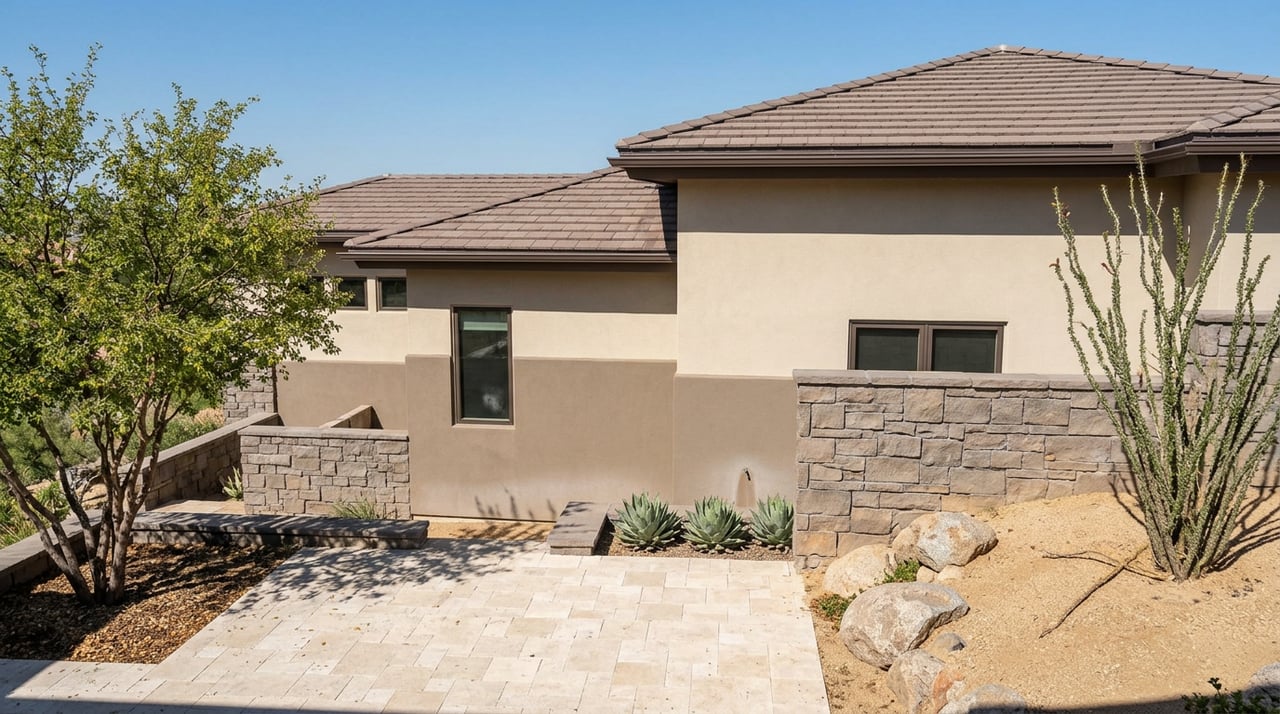
A homeowner who bought a hillside lot near Mummy Mountain or Camelback assuming they could reshape the yard the way they would on a flat parcel elsewhere in the Valley finds out fast that the math doesn't work that way here. And because height is measured from natural grade rather than finished grade, a design that sits right at the 24-foot limit on paper can fail final inspection once actual field conditions are surveyed. Builders who work this market regularly bank 12 to 18 inches of buffer into their plans for exactly this reason. Sellers who inherited a home built without that margin, or who added a casita without confirming it against the disturbance cap, are the ones showing up in that 121-day column.
Why This Shows Up at the Worst Possible Moment
Building in Paradise Valley runs on two separate approval tracks that move sequentially, not at the same time: the Hillside Building Committee review, then the full construction document review by the town's Building Safety Department. Missing that sequencing is one of the more common reasons a renovation timeline blows up right when a seller is trying to get a property market ready.
The same friction shows up during escrow, not just during construction. Inspection windows in Arizona resale deals typically run 7 to 10 days, with about 5 days for title review and 21 to 30 days for loan and appraisal contingencies on financed deals, closing in 30 to 45 days total. That's a tight window for a buyer's inspector to raise a slope or drainage question that the seller hadn't already resolved. A pre-listing inspection and a clean packet of permits, receipts, and improvement records isn't paperwork for its own sake here. It's the difference between an inspection period that closes on schedule and one that reopens price negotiations three weeks before closing.
Thin comparable sales compound the problem. With so few transactions at this price point each month, a hillside property without documented permits and disturbance compliance gives an appraiser very little to lean on, and that's exactly when appraisal-gap negotiations start. Sellers who show up with a comps packet, a list of improvements, and copies of permits are giving the appraiser a reason to support the number. Sellers who show up without one are asking a cash-flush, patient buyer pool to take it on faith.
Where the Demand Is Actually Concentrating
Not every corner of the market is moving at the same pace. Demand for organic-modern architecture in the Camelback Country Estates and Cherokee corridor has been rising through 2026, and teardown opportunities at the $2 million to $3 million land-only price point remain active, where a rebuild in the $5 million to $7 million range can produce a finished asset around $8 million to $12 million, a tier below the $15 million-plus trophy segment.
Smaller gated communities continue to trade in their own lane entirely. Cameldale Estates, an 11-home enclave at the base of Camelback designed by Drewett Works, and Paradise Reserve, a guard-gated hillside community, both sell on scarcity as much as finish level. Azure at Ritz-Carlton, the 66-home Shea Signature community built in partnership with the resort, appeals to a different buyer altogether, one looking for concierge-level services on a smaller, already-engineered lot rather than a raw hillside parcel with a permitting process ahead of it.
The common thread across all of these is that the buyers shopping them are sophisticated enough to ask about slope designation and permit history before they write an offer, not after.
What This Means If You're Listing or Buying Right Now
If you're preparing to sell a hillside property, the highest-leverage move available to you isn't another round of staging. It's assembling the file: permits, plans, hillside committee approvals if any work was done, and a geotechnical or slope report if one exists. If you're buying, ask for that file before you write an offer, not during your inspection period. And if a listing has been sitting well past the current median, ask specifically whether the delay traces back to price or to something in the paperwork that hasn't been resolved.
A Few Questions Worth Asking Before You List or Offer
Does every hillside lot in Paradise Valley go through committee review? Generally, yes, if the building-site slope reaches 10 percent or the parcel appears on the town's hillside map. Confirming your parcel's status early, before you assume a flat-lot timeline applies, is worth a call to the town's planning staff.
Can a casita be added without triggering the disturbance limits? Guesthouses are permitted on most one-acre-plus lots, but the structure still counts against lot coverage and disturbance caps, and it cannot be rented separately as a short-term rental. Confirm size and placement against your specific slope category before you design one.
Why do cash buyers seem to have the advantage right now? Jumbo loan appraisals are harder to support when comparable sales are thin, so cash buyers avoid that risk entirely. A well-documented file narrows that advantage by giving any appraiser, cash deal or not, a stronger basis for the number.
If you're weighing a Paradise Valley purchase or getting a hillside property ready to list, The Mitchell Group AZ can walk through what your specific parcel's slope designation means for timeline and disclosure before you're mid-escrow figuring it out. Get Your Home's Value and let's talk through what's actually in your file.